
Why the six-pin Tag-Connect counts differently
The first time you place a Tag-Connect pattern in a layout, something looks wrong: the six-pin TC2030 numbers its contacts differently from the ten- and fourteen-pin parts — even though the contacts sit in exactly the same arrangement. It is not a datasheet error and not an oversight. It is the fingerprint of a design decision made early in the system's life.
The difference in one sentence. The arrangement is identical across all three families: two rows, contacts directly opposite one another. Only the numbering differs. On the TC2030, each column carries a pair — 2 above 1, 4 above 3, 6 above 5. On the TC2050 and TC2070, the lower row counts straight through and the upper row runs back the other way.
TC2030 — six contacts, in pairs
Every column carries a pair of numbers. That is exactly how an IDC connector is built: pin 1 faces pin 2, then 3 and 4, then 5 and 6. If you have the connector in mind, you can draw the pattern straight from it.
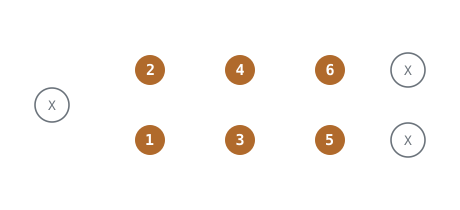
TC2030, viewed from above the board. Copper = spring contact, circled X = guide pin. One pair per column — the same assignment as on the IDC connector. Schematic; binding dimensions are in the manufacturer's drawing.
TC2050 and TC2070 — ten and fourteen contacts, wrapping
The arrangement is unchanged; the numbering is not. The lower row counts left to right, then the count jumps to the upper row and runs backwards. On the TC2050, 6 sits above 5 and 10 above 1 — a pair no longer shares a column, it occupies the two ends.
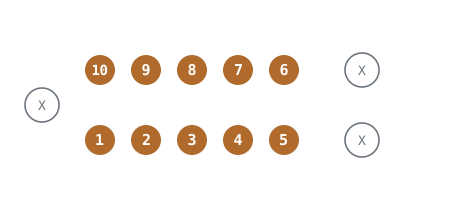
TC2050. 10 above 1, 9 above 2, 8 above 3 — the count wraps around at the right-hand end.
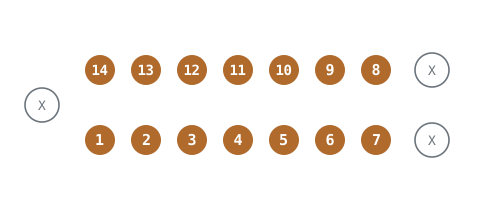
TC2070. The same scheme with seven contacts per row instead of five: 14 above 1, 8 above 7. Three guide pins here as well — one on the left, two on the right.
How it maps to the IDC connector
On the TC2030, the numbers sit relative to one another exactly as they do on an IDC connector: pin 1 opposite pin 2, 3 opposite 4, 5 opposite 6. If you know the connector, you can draw the pattern from memory.
That stops being true on the larger families. The numbers still match — contact 7 carries signal 7 — but their position is something else entirely.
| Family | Lower row | Upper row | Opposite each other | Same as IDC? |
|---|---|---|---|---|
| TC2030 | 1 · 3 · 5 | 2 · 4 · 6 | n and n+1 | yes, 1:1 |
| TC2050 | 1 · 2 · 3 · 4 · 5 | 10 · 9 · 8 · 7 · 6 | n and 11−n | no, wraps |
| TC2070 | 1 … 7 | 14 … 8 | n and 15−n | no, wraps |
Where the break came from
The TC2030 came first. The problem it set out to solve: programming connectors were too big and too expensive. It was built to work with Microchip programmers, and those arrived on an RJ12 socket — six conductors, on a scheme that has nothing in common with the Tag-Connect pattern.
At the time that was no obstacle: whatever ran over the RJ12 cable ran just as easily over a six-way IDC ribbon — nothing had to be forced. Building the cable either from discrete wires or from ribbon was the obvious choice.
With only three contacts per row, nobody noticed that two pitches were pulling against each other: the spacing the spring contacts need, and the spacing of the conductors in the ribbon. Across three positions the difference does not yet add up to anything.
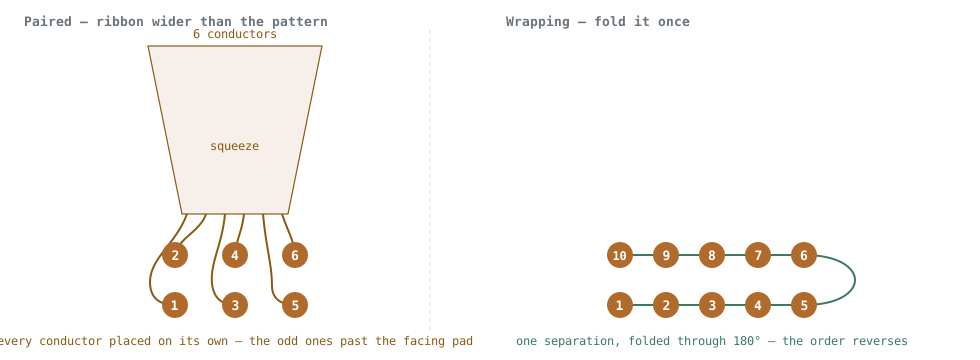
Where the break came from. On the left, paired numbering: the six-way ribbon is already wider than the pattern, so the conductors have to be squeezed together, and because 1 and 2 share a column every odd conductor has to be routed past the pad facing it. On the right, wrapping numbering: the lower row is laid in one pass, the cable is folded through 180° at the right-hand end and brought back over the upper row — the order reverses in the fold, and that is precisely why 10 ends up above 1. Schematic; the drawing shows the principle, not the assembly process.
Extending to ten and eventually fourteen contacts tipped the balance. The ribbon would have had to be slit over long stretches, and the conductors would have got in each other's way as they were laid onto the spring contacts.
The way out. A scheme whose 1.27 mm pitch matches exactly what arrives from the ribbon. One row can then be laid in a single pass, the cable folded through 180° and brought back along the other side — one separation instead of many, and not a single crossing conductor.
The TC2030 stayed as it was. Changing it would have broken every existing layout — and with three contacts per row the old scheme still works perfectly well. That is why the families carry two different numbering schemes to this day.
How we know
This page is not a summary of manufacturer documentation. We have worked with these cables since 2013 — we use them ourselves, we sell them, and we help customers with their layouts. What is written here comes out of that practice, and partly out of opening up failed cables to see how they are built inside.
That is why this page tells you why something is the way it is, rather than only that it is. For dimensions, tolerances and clearances the manufacturer's datasheets remain authoritative; for the question of why the six-pin part breaks the pattern, you will find nothing there.
What this means for your layout
- Do not infer the larger patterns from the TC2030. Anyone who has understood the six-way pattern and then draws the ten-way from it will get the upper row backwards.
- Moving from 6 to 10 contacts means starting the pattern over, not extending it.
- The signal number stays the signal number. What gets swapped is not the signal but its position — and that only shows up the first time you plug in.
- The guide pin is the reference, not the contact row. It fixes the orientation.
The matching cable
Once you have settled on a family, these three routes lead straight to the cables — each available with and without locating legs, and in the vendor-specific variants.
- TC2030 — 6-way, paired numbering
- TC2050 — 10-way, wrapping numbering
- TC2070 — 14-way, wrapping numbering
Coming from the Microchip world and familiar with the RJ12 route? The matching adapters are under Microchip (ICD/ICSP).
For dimensions, tolerances and keep-out areas, the Tag-Connect datasheets alone are authoritative.